

Safe Sleep for Infants & Preventing SIDS
- Nala Steib
- Jul 21
- 4 min read
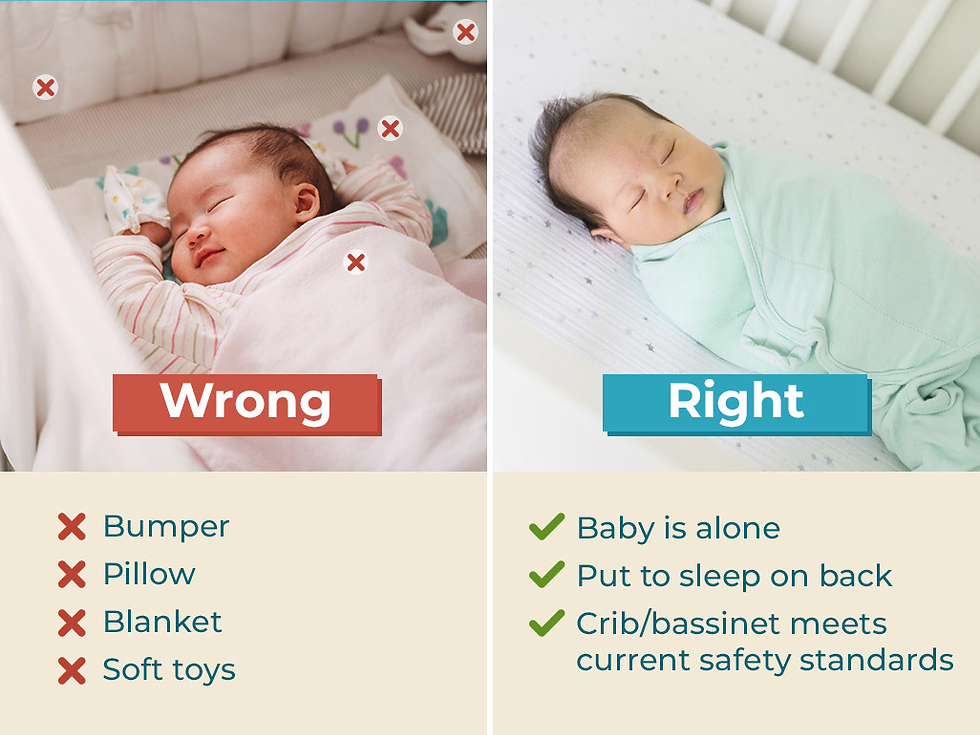
As a pediatric nurse & safe sleep subject matter expert, I spend a lot of time educating parents on safe sleep practices for their children less than 1 years old. I know at this age a lot of infants naturally find comfort and soothing in being under their parents while awake & sleeping and separation from them can cause anxiety for the child & restlessness for the parent.
While we want to ensure our children feel psychologically safe by providing them with physical closeness & comfort, co-sleeping & other unsafe infant sleeping habits can be detrimental to the physical safety of the child. Devastatingly, Sudden Infant Death Syndrome (SIDS) is the LEADING cause of infant (ages 1 month-1 year) death in the US & globally and does often time have a causative relationship with unsafe sleeping practices. While factors like congenital abnormalities, abuse & neglect, infection, etc. contribute to SIDS; we will be discussing the relationship between unsafe sleep & SIDS in this post.
This blog post is not made with intentions to judge parenting styles. It is made from a perspective of experiencing the consequences it has had on the lives of children & their parents & for a genuine desire to help parents not be in the number of those who have lost children to SIDS/ SUID. Before moving forward, this is a sensitive topic, but it can help to save infants' lives so they can live healthy & happy.
If you're wondering, how can positioning my baby on their belly to sleep, sleeping with my baby or allowing them to sleep with their favorite stuffed animal, blanket, pillow, etc. put their lives at risk...let me explain a few differences about babies & the facts...
The aforementioned factors can cause accidental suffocation & strangulation of the infant.
In 2022, the CDC estimated that 3500 infants die annually due to SUID attributed to unsafe sleep environments.
Their brains are still developing their breathing control center, sometimes if they have low oxygen levels in sleep their brains miss steps to arouse them & correct the low oxygen levels by repositioning, initiating deep breaths, increasing the heart rate, etc.
Their airways are smaller, shorter & narrower making them easier to occlude.
Babies don't learn to roll over fully & reposition themselves until about 6 months old.
Triple-risk framework: SIDS is thought to occur when 3 factors exist: 1.) The part of the infant's brain that controls breathing is still developing or defective. 2.) The child is in the 1st 6 months of life which is a peak incidence window. 3.) Environmental stressors are present inc.: Prone sleeping, overheating, soft bedding/mattress, objects that are suffocation hazards (stuffed animals, blankets, bumpers etc.), smoke exposure.
At this point you may be asking, what can I do as a parent, caregiver, loved one or healthcare provider to prevent this...Here are a few proven & evidence-based tips to put your baby to sleep safely & soundly.
Use the ABCs of safe sleep. Alone (baby sleeps alone in the crib with no other person or objects), Backs (place baby on their back for sleep, NOT face down or side lying), Crib (The baby sleeps in a crib with a firm, flat surface, & fitted sheet)
Educate others about safe sleep that may be caring for your child.
Ask your health care providers for education & resources on safe sleep.
Keep loose blankets, pillows, toys, bumpers, diapers, wipes, etc out of the crib.
Swaddle baby in a light sleep sack.
Avoid exposing the baby to smoke.
Breastfeed if possible. At least 2 months of breast feeding is associated with decreasing SIDS risk by 50%! The longer the baby is breastfed, the higher the reduction of SIDS risk.
Room sharing without bed sharing is okay! Sharing a room has proven to reduce SIDS risk by 50%.
Avoid routine seat naps (car seat, stroller, bouncer, or anything that allows the baby to fall asleep in a semi-reclined or upright position as this can block their breathing passages. If the baby falls asleep in the car seat limit this to the travel time & reposition them to a flat surface when appropriate.
Position car seats so you can see the baby's face & never leave them unattended in one.
Tummy time while awake.
Keep the room at a cool temperature.
Stay up to date with vaccinations, this has been shown to reduce SIDS rates by 50%.
AAP recommends stopping swaddling once the baby learns to roll to allow the baby to self-adjust their position if they're at risk for suffocation.
I hope you have found this post useful! Share to educate other families!
~ With love, QTC.
Resources
Stringer, M., La
zzeri, J., Giordano, N. A., Polomano, R. C., Quigley, E., Ohnishi, B. R., Fray, M., Dunlevey, E., Hoffman, R., & Christ, L. (2025). An Evidence-Based Safe Sleep Program Is Associated With Less Infant Sleep-Related Deaths. Worldviews on evidence-based nursing, 22(3), e70022. https://doi.org/10.1111/wvn.70022
Moon RY, Carlin RF, Hand I; AAP Task Force on Sudden Infant Death Syndrome and the Committee on Fetal and Newborn. "Sleep-Related Infant Deaths: Updated 2022 Recommendations for Reducing Infant Deaths in the Sleep Environment." Pediatrics. 2022;150(1):e2022057990. Published June 21, 2022.


Comments